Designing for Awe
We celebrate the outputs of scientific discovery: the Nature paper, the press release. But we rarely protect the conditions that produce it. What if awe isn't a nice-to-have, but the hidden driver of the research that matters most?

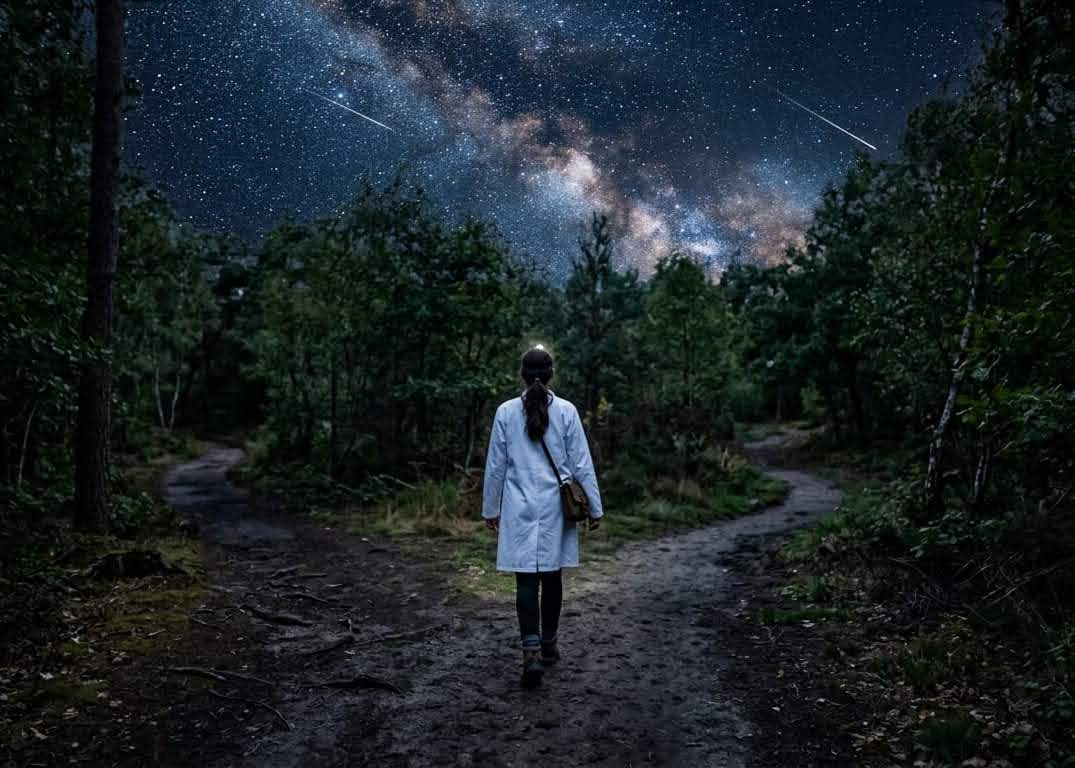
Recently I was at our Physics Department away day. The agenda was serious: geopolitics impacting student numbers, the UK's REF, student-to-staff ratios and transitioning UKRI funding models. These are important questions in higher education, and we were all engaged.
At the end of the day, a recent appointment - Prof Silke Weinfurtner - took the floor to speak about her outreach work at the intersection of physics and art. This wasn't simply art illustrating science: it was genuine co-inquiry on how we understand nature. At the end, we spoke, and she asked: we didn't come to this job to talk about cost recovery. We came because of the joy of science. How do we bring this back?
I stopped. This question named something that hadn't been spoken about all day. We were sat in the SKA Headquarters - the home of one of the most ambitious and curiosity-driven experiments ever devised - with 100 senior physicists, and not once had anyone mentioned the joy or awe that drew them to the discipline in the first place.
Paradoxically, the joy of science deserves to be taken seriously. It explains a lot about why people do research, what research gets done, and why those who fund research struggle to direct it.
What Awe is (and isn't)
Awe is the specific response to encountering something vast that exceeds your current cognitive framework; Keltner describes it as meeting with a concept that you cannot explain, stimulating a need for accommodation. It produces a 'small self': reduced ego and heightened curiosity. Counterintuitively, when we experience awe, we feel like we have more time to pursue our goals.
Awe sounds like something that scientists could do with to counter the more mundane cognitive decathlon of academia! But perhaps the link between awe and science is unsurprising: one way to expose ourselves to the unknown is by standing at the boundaries of knowledge. Similarly, the productive frontier for science is the edge of error, where models are almost certainly wrong: this is not ignorance, but also not mastery.
There is a nuance. We need to distinguish two epistemologies. Bronowski's humanist, anthropocentric perspective for awe lies in our human ability to understand nature. This is in contrast to a nature-centric, objective view of awe, associated with mathematical platonism. Neither are wrong and both are magnificent, nonetheless, the latter recognises the awe of genuine confusion and of results that make no sense. It de-centres humans, defines the space where being lost is awesome, and is intrinsically the home of Large World mysteries.
Organisations often celebrate fundamental research activities, from congratulations on a Nature paper, curiosity-driven workshop funding, blue sky thinking afternoons. But these are simulacra of awe - celebrating the process of discovery, rather than the condition of not knowing. In other words, they champion the evidence that awe occurred, without grasping the conditions in which it can occur again.
Awe can drive researchers to tackle the highest-risk and highest-knowledge-gradient problems: where failure is likely and where Large World mysteries abound. It can lead to talented researchers dedicating their life to the obscure (or maybe to the incredibly valuable). To develop a concept of organisational return on awe, we need to understand how our structures can act to free or stifle uncertainty.
Awe and psychological safety
Being comfortable to express that you do not know - psychological safety - isn't a nice to have. Google's Project Aristotle showed it is the biggest predictor of high-performing teams. This is easy to say, and is possible to create at team level, but almost impossible to embed as a default organisational state.
Last week I sat on a panel for Leading for Researchers - an internal scheme to develop research fellows into leaders. The cohort's final presentation expressed what they need from the institution: one academic spoke with frustration, of the need for clarity on whether he is expected to deliver outputs frequently or have freedom to focus on a multi-year awesome target. While both researchers and leaders know the value in working on the big, knotty problems, the organisation pulls away; it wants to measure performance with tangible outcomes (thanks QS Rankings and REF).
Imposing quantifiable purpose on research runs counter to awe-driven focus. In the seminal work Creativity, Csikszentmihalyi introduces the concept of autotelia (an activity that has a purpose within itself rather than relying on external rewards or motives):
What [scientists] seem to describe, however, is the joy of discovery, of solving a problem, of being able to express an observed relationship in a simple and elegant form. So what is rewarding is not a mysterious and ineffable external goal but the activity of science itself. It is the pursuit that counts, not the attainment.
It is simply impossible to align autotelic behaviour with auditing; citation metrics, h-indices, research rankings, are the structural antithesis of creativity, and are set against psychological safety. An organisation cannot schedule, mandate, or redirect awe. It can only protect the conditions in which it might occur.
Ambidexterity and the PhD
The conditions for awe requires organisational ambidexterity: the ability to optimise what you know (the domain knowledge) and explore what you don't. True creativity comes the the combination of deep domain knowledge with exposure to that moment of the unknown.
These are hard to balance; exploration and exploitation at the individual level biases towards defensible short-term returns. For an organisation, the equivalent is to shift reward architecture towards exploitation of existing knowledge while speaking the language of exploration: this is the drive towards the simulacra of awe.
We can, however, design for awe. One solution is structural separation - protected spaces with different metrics and permission structures - spanning organisational solutions such as the IAS model to individual carve-outs such as Silke's work with the art-lab. These design encounters with unfamiliar cognitive frameworks, permitting genuine uncertainty; awe by design.
These are rare and precious, but not unique. The standard PhD degree is almost perfectly engineered: one problem, protected time, and a supervisor who can guide to the frontier provide the structured encounter with the unknown that still generates the best designed structure for scientific awe. Despite funders looking for return-on-investment from the PhD, the best students are those that are driven by a sense of discovery and curiosity, where my role as supervisor is to provide the context and resources to explore.
What awe-walks are for nature, the PhD is for science. But in finding the problem to dedicate yourself to, it really matters who chooses it.
Endogenous vs Exogenous Awe: Who chooses?
Universities have historically evolved to support endogenously generated awe, individuals following curiosity to a place where awe is the product. Here, motivation is intrinsic and self-regulating: this is more the Vannevar Bush model of science as an Endless Frontier and less the Kratsios New Golden Age.
Intrinsic motivation for curiosity appears to be a human trait, but having agency is critical for us to approach a problem: we are open to awe when we ask 'can I make sense of this if I try?'. This question is deeply personal, but an organisation can create the conditions where it can occur by providing role autonomy. A positive feedback mechanism results where autonomy drives positive affect which drives further creativity.
Universities, at their best, are still capable of supporting the genuine article of awe. Their current tragedy is the progressive removal of the conditions, while perversely maintaining the rituals.
But what if we want to harness the power of awe to support national strategy, commercial income, or environmental or societal impact? In other words, to direct it? And if research base is a resource, is it possible for an organisation to capture a return on awe?
The agency that organisations provide to researcher to follow their curiosity spans purely intrinsic drives – such as at Institute of Advanced Studies – to almost purely extrinsic in a defence department lab. Some of the most exciting organisational experiments have explored this spectrum: Bell Labs, ARPA, Google X, and neo-labs. Such structure substitute personal awe for vicarious awe and a designed-in feeling of making the impossible, tractable; they provide a well-resourced home for collective exploration.
What Embedding Awe Looks Like
Awe is the experience, curiosity is the drive towards it, interest is what sustains it and creativity is the methodology to approach it. For the right people in the right conditions, this positive feedback loop has delivered some of the most dramatic advances in human history. The right conditions are neither mysterious nor expensive: protected time for confusion, organisational permission to not-know, a community who are visibly driven by hard problems, and cognitive slack to dwell on anomaly.
This loop is the hidden driver of the under-loved research that doesn't (yet) centre impact, because it's still lost in ambiguity. While "Ivory Towers" are a pejorative on academic removal from the immediate, this reflects the long-term human need to tackle ambiguity-tolerant research that doesn't fit into this cycle's REF impact statement.
Nevertheless, while innovative ecosystems have long considered awe to be a cultural aspiration this has rarely been treated as a design problem. I loved Silke's approach because it provided a concrete structure for awe – enforced uncertainty in a space for creativity.
In meeting heads of research group (collections of 5-30 academics), I've opened with a question: what's the most exciting thing in your research group that isn't being done by you? I thought I was surfacing collegiality and co-accountability. I should have taken a step backwards. A better question may have been: what is the most exciting thing we don't understand in your area?
If we want a metric for this, it isn't hard to find: not citations of discovery, but tolerance for the conditions that precede it. Call it an awe ROI, measured not by what an institution celebrates, but by what it is willing to protect well before it knows what the payoff will be. Away days are a reasonable place to start asking the question: not as the last item on the agenda, but the first.