A Start Up is (Not) All You Need: Exploring the Innovation Design Space
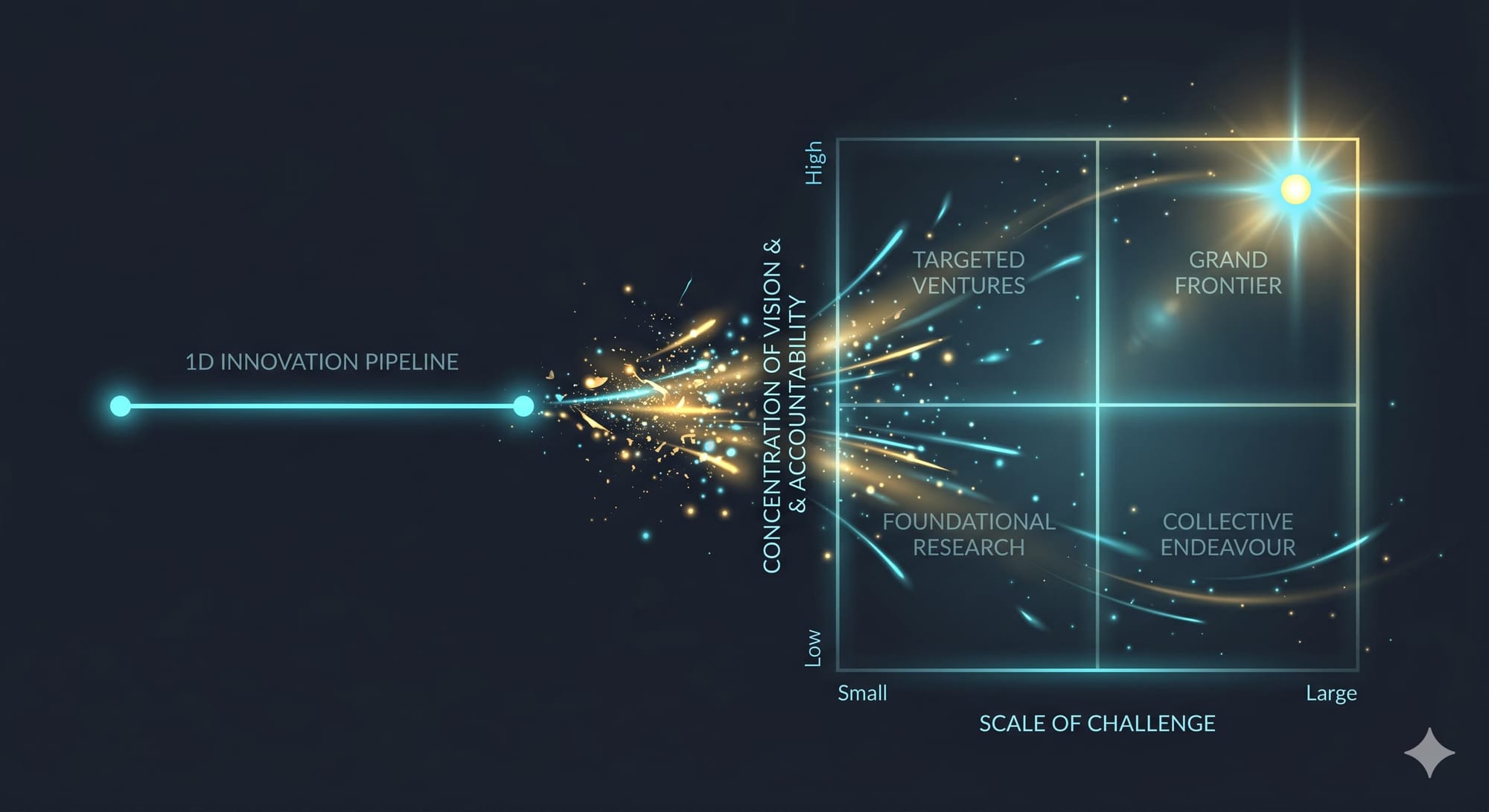
Seen through a one-dimensional lens - public research on the left, commercial spin-out on the right - ARIA's investments look indefensible. But the map is wrong, not the decisions.

ARIA is an unusual beast in UK research funding. It is fast, flexible, and - to many - confusing. But now it at least shares one characteristic with other public sector funders; it has a PR problem.
The wide-spread condemnation of the investment decisions that spread across the media surprised me; the UK has lots of funding agencies with different goals (regional investment, fundamental research, UK start-ups) but ARIA has a specific remit to seek high-risk impact with benefits flowing to the UK. Unnecessary restrictions can only reduce their impact, right?
But then it hit me: critics viewed innovation on an outdated one-dimensional map from public-owned university research to private-owned industrial research. Viewed through this lens, Renaissance Philanthropy and Pillar VC both look like extractive private sector actors. Instead, Renaissance are the leading edge of a philanthropic infrastructure that is becoming a new pillar of the innovation ecosystem.
ARIA's failure was not the specific funding decisions it made, but in having no shared language to clearly defend them. This is the language of innovative organization design literacy.
The One-Dimensional World
There is an outdated default mental model: on the left, public-funding carries out research for knowledge, and on the right, commercial spin-outs carry out innovation for commercial impact.
Over a decade ago Mazzucato radically challenged this: the iPhone did not emerge fully formed from an idea in Palo Alto. It was the product of decades of government funded research programmes assembled by a company with a concentrated vision.
The view that venture capital is the sole driver of innovation is both intellectually lazy and fundamentally wrong; it also systematically undervalues public investment. As Paul Berg (Nobel Prize in Chemistry, 1980) put it:
Where were you guys [VCs] in the '50s and '60s when all the funding had to be done in the basic science?
The implication is that the state absorbed the risk, private capital captured the returns, and therefore the post hoc conclusion that private capital is the cause of innovation is deeply flawed. Berg's point is that the VCs add value after the state has derisked the innovation.
This is not to say that there is no role for VC funded start-ups, particular for commercially valuable research. But impact is multi-faceted - health, society, environment; if VC-funded start-ups are your hammer, you are only aligned for one type of nails.
No one asks CERN to pay out dividends because CERN was never shaped as a dividend-seeking entity.
The Innovation Matrix
A richer view of innovative structures can be seen using two axes: the scale of the challenge, and the concentration of vision and accountability.
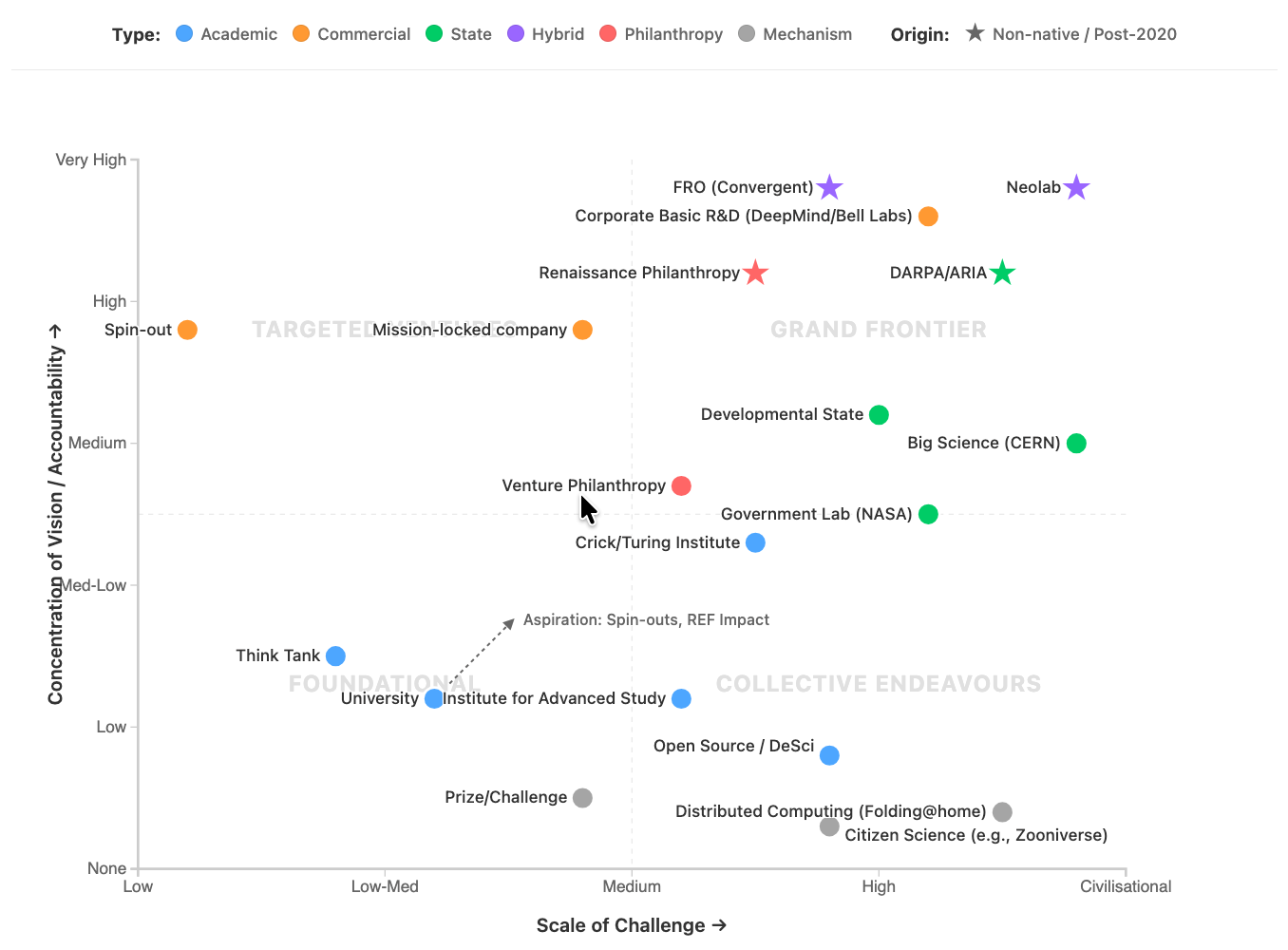
This produces four quadrants:
- Foundational Research: Distributed ownership, small-scale challenge; the optimal structure is a sovereign expert network where individuals are trusted to self-direct. Coordination happens through peer review and shared norms rather than hierarchy. (e.g. academic research, think tanks)
- Targeted Ventures: Concentrated ownership, small-scale challenge; the optimal structure is a focused organisation with clear accountability and a defined commercial or mission target. Individual responsibility for success and failure is the primary performance lever. (e.g. regional start-up, mission-locked company)
- Collective Endeavour: Distributed ownership, large-scale challenge; the optimal structure is a low-barrier participation model where scale of contribution matters more than depth of individual commitment. Coordination happens through shared infrastructure and open standards rather than management. (e.g. open source software, citizen science)
- Grand Frontier: Concentrated ownership, civilisational-scale challenge; the optimal structure combines a single accountable vision-holder with the resources and mandate to pursue binary, high-risk outcomes. This is a directed programme with a defined finish line. Notably, CERN lands here - they have collective governance but directed programmatic concentration. (e.g. corporate R&D lab, neolab, FRO)
Each quadrant demands a different structural solution; the specific problem-structure fit provides organizational leverage. No quadrant is better than another. However, some organisations strive to move; University researcher leaders know that they have to balance the individual autonomy of their 11th Century foundations with the need for large scale interdisciplinary solutions to critical challenges.
Grand Frontiers need new types of organizational structure. A notable entrant is Focussed Research Organizations (FROs); Convergent are early experimenters in this quadrant, providing a single-topic time-bound research-enabling organization. In this quadrant more then any, it is clear that a start-up is not all you need.
The UK's Missing Quadrant
Every government can see the value in high-risk, high-reward research. It is what the public sector do best, it is enabling and transformative... and it is hard.
The top-right quadrant - grand frontier - is where transformative, directed, and high-accountability innovation lives. We see FROs, neolabs, and DARPA-style programme management; these are organisations built around a defined finish line and a single accountable vision-holder.
Gamick calls this the "General Manager" model - a founder-type who feels personally responsible for an outcome, not just for working on it. The high-trust, high-accountability investment in an individual who is motivated to solve a large or civilization-scale problem might look like scaled-up academic research. But a DARPA programme is not a bigger version of a research project - it combines a visionary challenge with a tendency towards execution.
The UK has ARIA, almost alone*, to provide
A singular focus on high-risk, high-reward research [with]... a high tolerance for risk and failure.
It also has almost no philanthropic infrastructure operating at scale, unlike the US where foundations such as Moore and Schmidt actively fill the quadrants that government and commercial operators won't.
Small-scale philanthropic moves are possible. A $1M SPIE endowment I led to fund return-from-industry PhD scholarships in photonics - a deliberate route for practitioners to re-enter foundational research - is one example of deliberately engineering the porosity between quadrants. But this is an individual bet, not infrastructure.
The takeaway from Mazzucato's "The Entrepreneurial State" is the importance of the state to fund - but also, crucially, shape - innovation markets. This will require the correct purpose-built organizational structures, and not endlessly repurposed spin-out process.
Organisational Design as a Navigation Tool
When a national funder, a research leader, a VC, or a founder tries to work from a one-dimensional map, only two structural decisions seem possible: public-sector university research, and commercial start-up research. Despite the pluripotent potential of start-up, this remains a rigid taxonomy which can present a false dichotomy to researchers.
The two-dimensional reality shows that there are many more tools in the innovation toolkit. There is porosity between the quadrants, and both researchers and organizations can move between them. The researchers who thrive in the next decade will understand this map, and move deliberately.
For capital allocators, this means recognising that applying a standard seed-stage template to a grand frontier problem is a structural misallocation of capital. The next defining breakthroughs will belong to those who realize that innovative organizational design is just as critical to deeptech success as the science itself.
Footnote
* The UK does has some outliers: the Crick Institute has no departments and acts as a collision space for biomedical science, the Alan Turing Institute has recently shifted towards a challenge-led national institute, and funders such as Wellcome can provide patient capital on timescales longer than government. But these are few, and domain specific.