The Parkinson Research Group
We build the tools that tell you what your materials are actually doing.
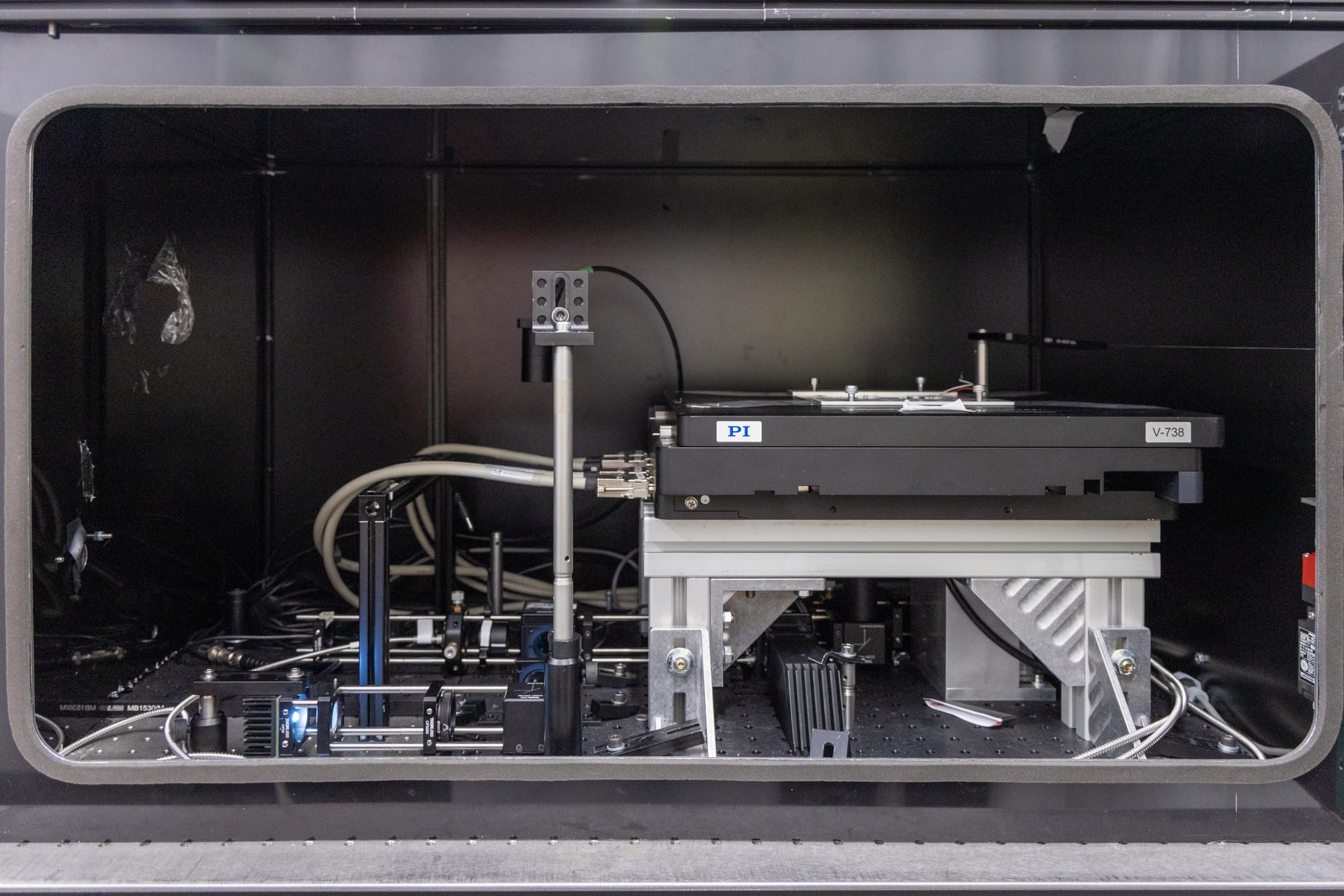
Our work sits at the intersection of photonics, semiconductor nanoscience, and data-driven measurement. We develop high-throughput, automated spectroscopy systems that can characterise thousands of individual nano-scale devices — nanowire lasers, micro-LEDs, quantum emitters — and extract statistical insight that single-device measurements simply cannot provide.
The goal is not just better data, but better decisions: about which materials to grow, which devices to build, and where the unexplored space in a parameter landscape actually lies. Increasingly, we couple automated measurement with machine learning and Bayesian optimisation to close the loop between experiment and design.
The group
We are based in the Photon Science Institute at the University of Manchester, with active collaborations across the UK, Europe, Singapore, India, and Japan.
What we work on
Nanowire lasers and emitters — understanding and optimising the statistical distribution of threshold, wavelength and efficiency across large device arrays, moving from characterisation towards automated design.
Quantum photonic structures — single photon emitters, nitrogen-vacancy centres, and integrated photonic devices, studied at scale using correlative microscopy.
AI-assisted materials discovery — applying Bayesian optimisation and high-throughput methods to semiconductor growth, closing the loop between measurement and recipe design.
Funding and partners
The group is supported by a UKRI Future Leaders Fellowship (Big Data for Nano-electronics), with partners including AIXTRON, Nanoco, NPL, LayTec, A*STAR Singapore, IIT Kharagpur, and the Universities of Cambridge, Strathclyde, and Lund.
Joining the group
We are a small, international group that values rigour, curiosity, and the ability to work across disciplinary boundaries. If you are interested in PhD or postdoctoral opportunities, please read about current openings before getting in touch.
We particularly welcome applications from candidates with backgrounds in physics, photonics, data science, or electrical engineering — and from those who want their research to connect to real-world materials challenges.